
Shopping Cart
There are no more items in your cart

Ephyra: the breakdown
Ephyra is a boulder problem located in Chironico, one of the most renowned bouldering areas in Switzerland. It sits on the same boulder, to the left of the classic From Dirt Grows Flowers, 8C by Dave Graham, and in its final part it reconnects with Sissyfuss (8A+).
This line, opened by Jimmy Webb in 2019, is located in Schattental, a slightly more secluded sector, but well known for the quality of its granite and the variety of well featured boulders. The problem demands a wide range of movement, a balance between power and endurance, with continuous intensity across its roughly 4-meter span, and is consistently steep.
The start, in particular, requires strong tension and continuous core engagement: left hand on a flat pinch, right on a sloping crimp. From there, a compressive sequence unfolds, culminating in a dynamic crux on small, sharp holds that must be grabbed precisely in the face of the intensity that challenges movement accuracy, accompanied by aggressive and surgical heel hooks. It shifts from physical to highly technical sections, with no chance to isolate hand and foot movements. The climb is complete and demanding both at the start and finish, requiring great mobility control and endurance from the climber through the various transitions. The boulder stays in the shade for most of the day, and performance is often influenced by humidity. Ephyra has been repeated and praised by top climbers such as Niky Ceria, Giuliano Cameroni, Will Bosi, Yannick Flohé, and more recently by Elias Iagnemma and Simone Tentori.
Inside the process
We had the chance to talk with Iagnemma and Tentori to better understand the feelings and challenges that Ephyra evoked, during their recent repeats.
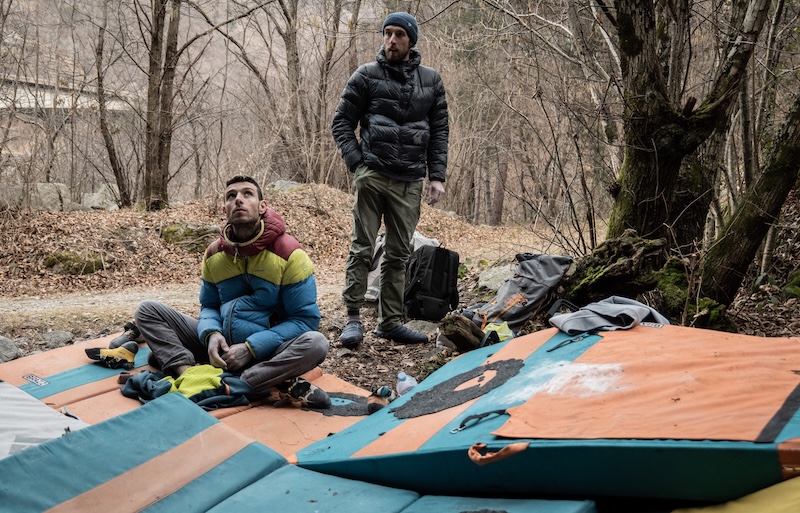
Elias Iagnemma: “Ephyra has always fascinated me, even since I went there to climb the line to its right. I promised myself I’d come back to climb it one day, and that’s what happened this winter! What inspired me the most was its unique morphology — being stretched out in every single move on the lower section gave me the right motivation to push out of my comfort zone and try once again to overcome what I perceive as one of my limits. The hardest part is definitely the lower section, but what challenged me the most was the final 'throw' of the stand start when I got there in one go: it still required a good deal of strength! For me, it's undoubtedly a masterpiece by Jimmy Webb.”
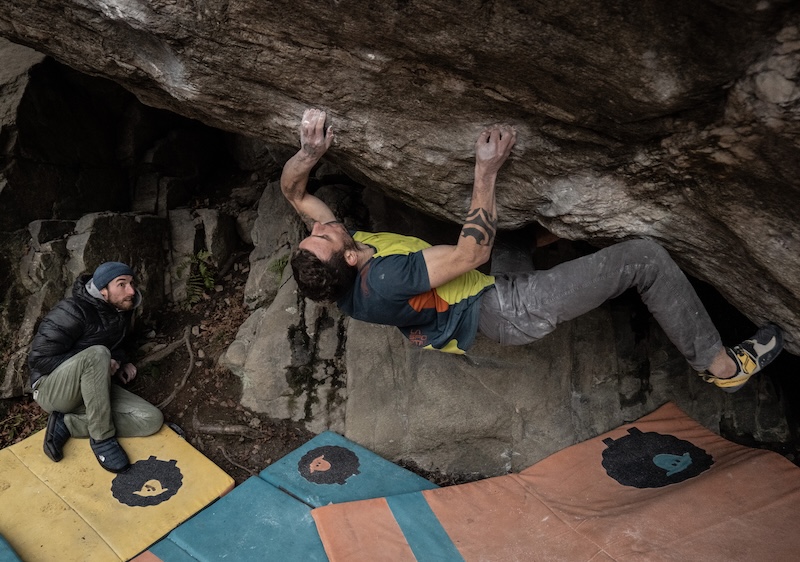
Simone Tentori: “I first tried the boulder a few years ago, out of curiosity, right after climbing From Dirt Grows Flowers, which shares a starting hold with Ephyra. But I was always shut down by the crux, that reach out to the left, and I left the project because I didn’t understand how it could work with my physical and technical abilities. This winter, Elias invited me for a session, and I was able to work again on that section. Thanks to Elias' motivation — and his method — I managed to figure out the move and realized the boulder was possible for me. One of the key moves that gave me particular trouble was the very technical and powerful heel hook on the left, along with catching the sharp little crimp with my right hand, which doesn’t allow for many attempts in a day. In these cases, managing energy and skin is essential to avoid cutting my fingers and ending the session too early. Sending Ephyra confirmed to me that I can solve hard sequences by working on them over time, both physically and mentally — and I can’t wait to apply the same attitude to even harder lines!”
Approach and padding
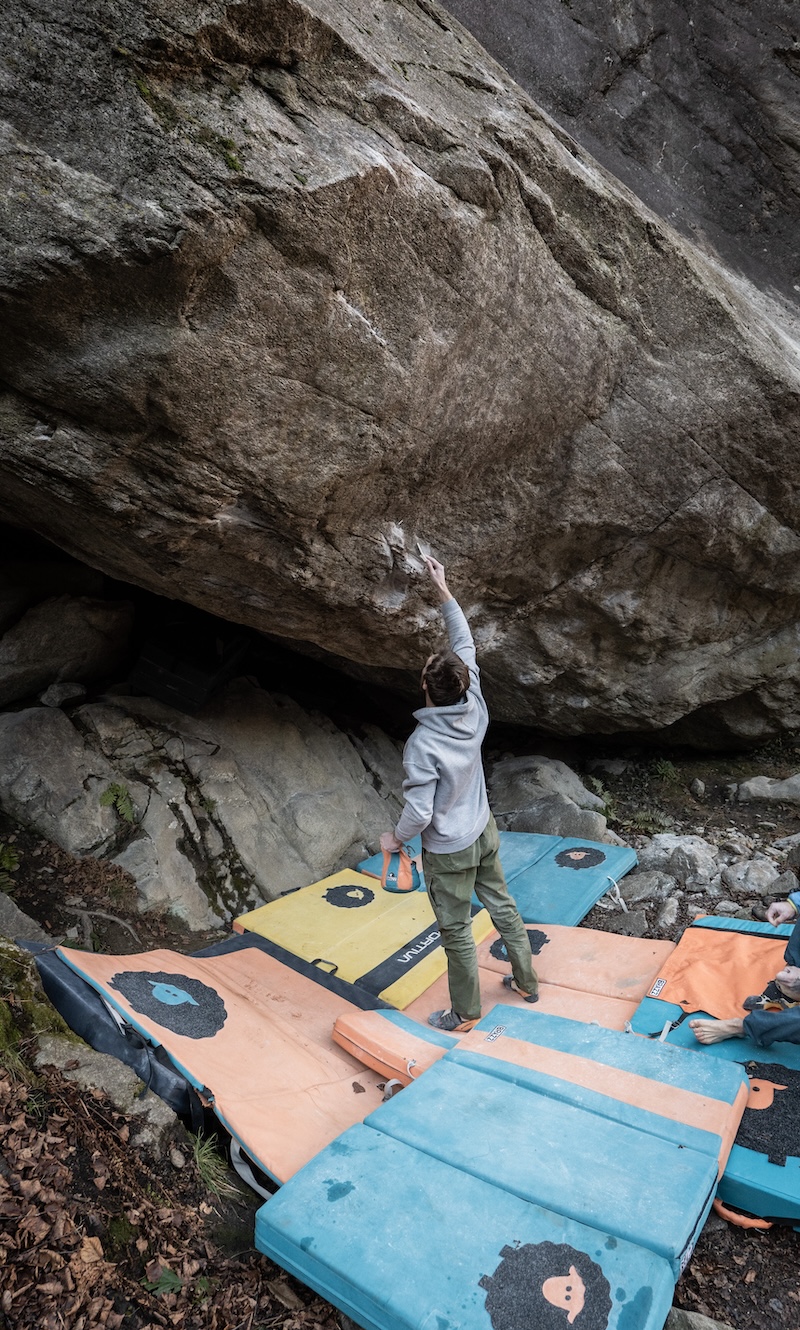
15 minutes of light uphill walking on a dirt road leads to the boulder. Given the technical characteristics and average height of the boulder, and according to accounts of previous ascents, it's advisable to use at least five crashpads, ideally of different sizes to cover the uneven terrain and the large surface area where a back-fall is likely. To avoid injuries caused by awkward body positions required by the boulder, avoid overly worn, soft, or bouncy pads.
A very large crashpad (ideally taco-style) can be used for general coverage of the main area. On top of this, smaller pads can be added to protect critical zones (cruxes and heel hook positions), and to allow secure attempts on individual moves without constantly repositioning the big pad. A large sitpad is also very handy — it provides extra protection and a clean surface to rest your feet without dirtying your shoes. Many climbers also prefer carrying a deckpad, which is ideal for covering the gaps between crashpads and making the landing zone more uniform and solid, especially when combining pads of different brands and firmness levels.
Protecting the boulder
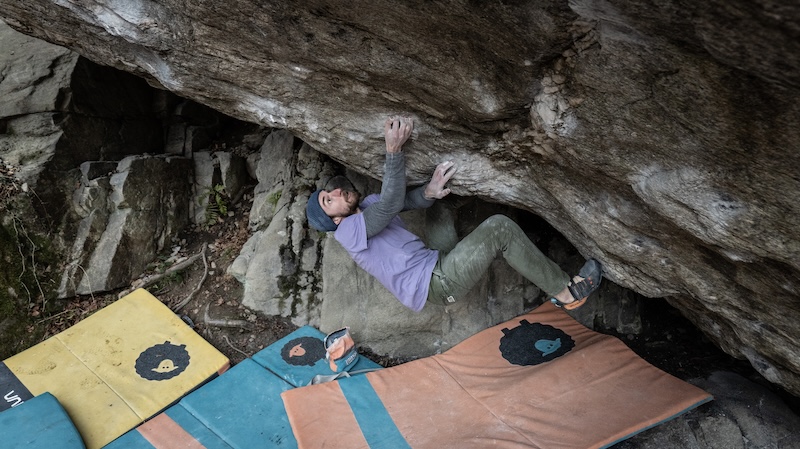
Bouldering also means taking care of the rock. Every boulder demands specific attention, depending on local weather, rock quality, hold texture, and climber traffic. Ephyra deserves particular attention, especially in its initial section (as from the stand start upwards, it sees less traffic due to its difficulty and nature). Sharing space with the nearby From Dirt Grows Flowers, it gets many attempts, which increases the risk of holds getting dirty or polished. That’s why it’s essential to act responsibly: brush off chalk after every session and, most importantly, clean off rubber marks from climbing shoes. Taking care of the rock is part of climbing — it’s a sign of respect for nature and for those who will climb after us.
What Ephyra leaves us
Ephyra is not just a hard boulder — one that only a handful of expert climbers dare to try — but it's also a perfect example of what makes outdoor bouldering so captivating: aesthetics, precision, mental and physical strength. It’s the kind of experience that tests the true boulderer, requiring preparation, the right gear, and a deep study and examination of how one can move with what the rock presents. And maybe it also takes the right company to help push us beyond our human and physical limits.
Article: Ludovico Peroni
Photos & Video: Alessandro Rinaldi
Editing: Artur Ryszka
Comments (0)